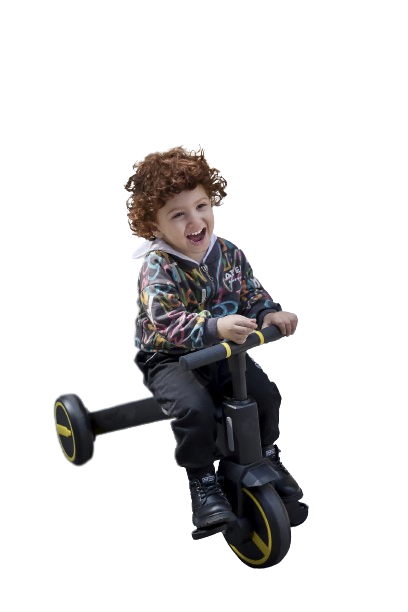
Tricycle vs balance bike is one of the first choices parents face when a toddler wants wheels. They look similar, but they do different jobs. A tricycle is stable and can be pushed and steered by an adult. A balance bike teaches balance and is ridden by the child alone. Which is better depends on your child’s age and on what you want it for.
Tricycle vs balance bike: the difference in short
| Tricycle | Balance bike | |
|---|---|---|
| Wheels | Three | Two |
| How it moves | Pedals, or an adult pushing | The child pushes off the ground with their feet |
| Who controls it | The child, or an adult with a parent handle | The child only |
| What it practices | Pedaling and steering | Balance and steering |
| Typical use | Walks, the park, the driveway | Short rides the child does alone |
What a tricycle does well
- It stands up by itself. A child can sit on it without having to balance, which suits younger toddlers.
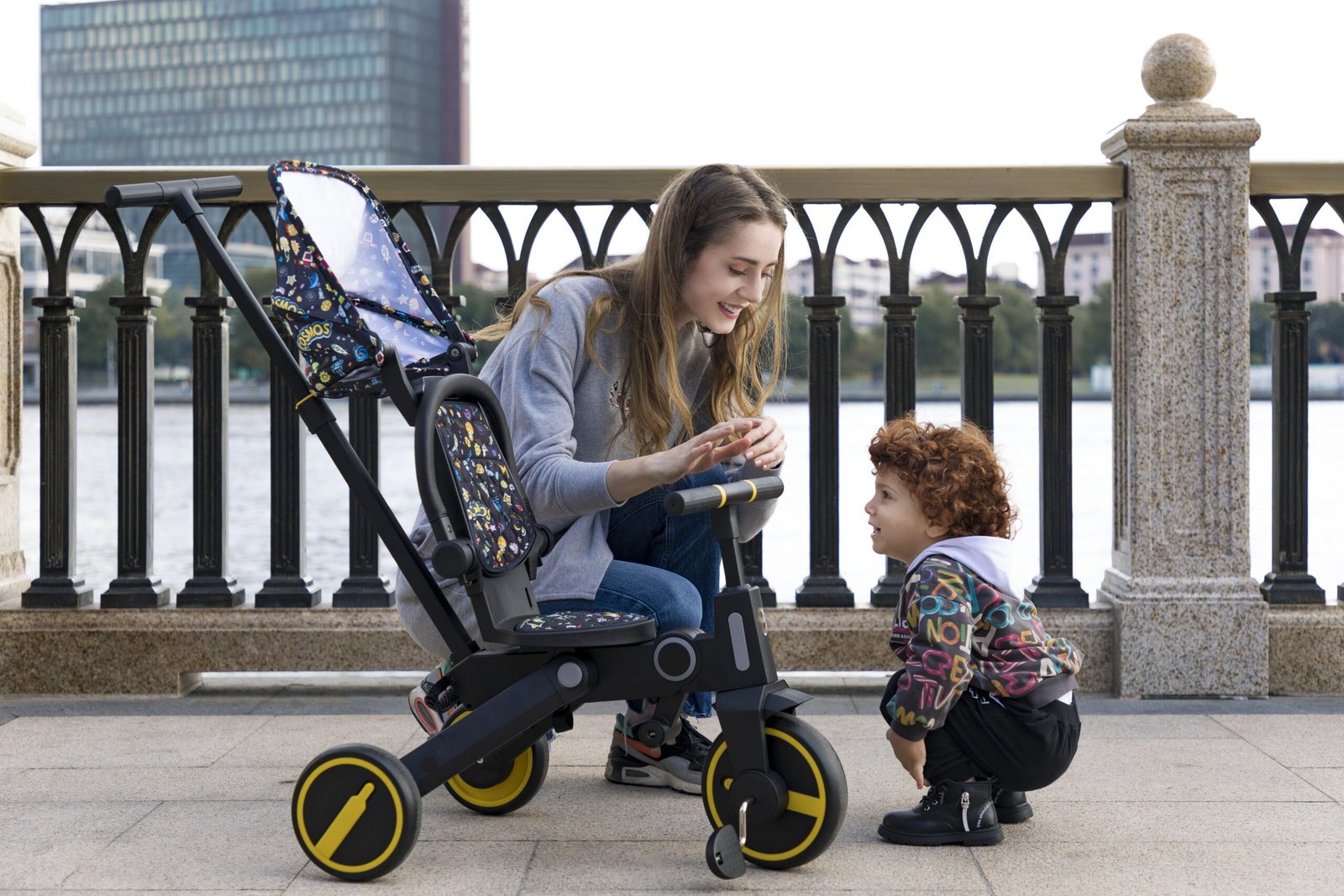
- An adult can drive. A push tricycle has a parent handle, so you can take a child who is too young to pedal on a real walk and keep control of the direction.
- It can hold a small child in place. Many push tricycles have a harness and a safety bar.
- It carries things. A canopy, a basket and a bag make it useful for longer outings.
What a balance bike does well
- It teaches balance. The child learns to keep a two-wheeler upright, which is the hard part of riding a bicycle later.
- It is simple and light. There are no pedals or chain, so there is little to adjust.
- The child is in charge. They decide how fast to go and put their feet down to stop.
Where each one falls short
A tricycle does not teach balance. A child who moves from a tricycle to a bicycle still has to learn it then. Tricycles can also tip in a sharp turn or on a slope, which is why the American Academy of Pediatrics recommends one that is built low to the ground with big wheels.
A balance bike has no harness and no way for an adult to push or steer, so it only works once a child walks confidently and can put both feet on the ground while seated. When they get tired, you carry the bike home.
Which one for which age
| Age | What usually works |
|---|---|
| Under 18 months | A push tricycle with a harness, a safety bar and a parent handle |
| 18 months to 3 years | A push tricycle for walks. A balance bike can work too, if your child walks steadily and reaches the ground from the seat |
| 3 to 5 years | Either one. A tricycle for pedaling, a balance bike for balance |
Check the age range and the seat height the manufacturer gives for any model, and see our guide on what age a toddler can ride a tricycle for more detail on each stage.
Do you have to choose?
Not really. Many families use a push tricycle from the first year for walks, then add a balance bike later for balance practice. If you want only one, think about what you will do most. For walks where you set the pace and the direction, a tricycle with a parent handle is the practical choice. For independent practice in the yard or the park, a balance bike is.
Whichever you pick, the safety rules are the same
Use a helmet that fits, put closed-toe shoes on your child, ride away from cars, driveways and pools, and stay close.
If you choose a tricycle
Newtronx foldable tricycles are made for ages 10 months to 5 years. They start as a parent-steered ride with a harness, a safety bar and a canopy, and convert to a pedal tricycle. See the Adventure Pro, the Trixplorer or all our toddler tricycles, and read how to choose a toddler tricycle before you buy.